How Banking-as-a-Service Actually Works — Lessons from Magnetiq Bank’s Turnaround
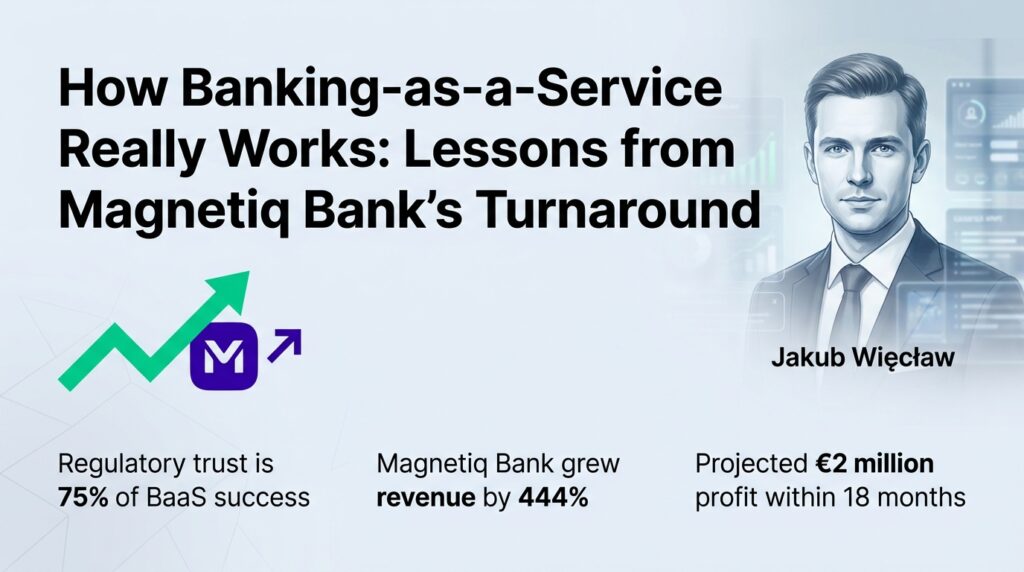
Jakub Więcław, Chairman of the Management Board at Magnetiq Bank, built one of the most credible track records in European Banking-as-a-Service (BaaS). Before joining Magnetiq Bank, he was part of the leadership behind Vodino Ion — a BaaS provider acquired by UniCredit for close to €300 million. In under 18 months at Magnetiq Bank, he reversed a €1 million loss into a projected €2 million profit and grew revenue by 444%. This post breaks down how that happened — and what it means for the future of embedded finance in Europe.
TL;DR / Quick Takeaways
– A full banking license combined with a strong regulatory relationship accounts for roughly 75% of BaaS success — non-bank alternatives face a structural ceiling
– Magnetiq Bank turned from €1 million in losses to a projected €2 million profit in under 18 months, driven by daily profitability tracking, flat team structures, and deliberate lessons drawn from past failures
– Time to go live is the real competitive differentiator — Magnetiq Bank cut delivery time for a Lending-as-a-Service launch in Germany from 12 months to 6
– The BaaS market is bifurcating: large pan-European banks will retain direct client relationships; specialist BaaS providers like Magnetiq Bank will power the fintech layer underneath
What Is the Future of Banking — and Is Anthony Jenkins Right?
Former Barclays CEO Anthony Jenkins predicted that banks as standalone brands will disappear — replaced by retailers, platforms, and service providers with embedded finance running quietly in the background. Jakub Więcław agrees, but only partially.
His view on how the market will split:
– Large pan-European banks with multi-country client relationships will survive for the next 20–25 years
– Specialist BaaS providers will power fintech companies in both B2B and B2C segments, operating as invisible infrastructure
– End customers — like a 14-year-old who pays by phone and has no idea whether Visa or Mastercard processed the transaction — will increasingly not care about the brand behind the transaction
The regulatory burden is also a structural driver. Not every fintech company wants to obtain and maintain its own banking license. They will increasingly partner with licensed banks like Magnetiq Bank to access compliance infrastructure, AML/KYC teams, and payment rails — and focus their own resources entirely on building client-facing products.
Why Are Some BaaS Providers Failing While Others Scale?
The BaaS space has seen high-profile collapses and regulatory interventions. Solarisbank — focused primarily on the German market — is a clear example. It failed to maintain the right balance between risk appetite, sales expectations, and regulatory compliance. The German regulator eventually required Solarisbank to obtain approval for every new deal before proceeding — a near-fatal operational constraint.
The lesson is direct: a good relationship with your regulator, and a regulator that genuinely understands the BaaS and embedded finance model, is worth approximately 75% of your success. The remaining 25% comes down to how effectively you deliver products to end customers through fintech partners — and how clearly those partners understand the cost structure and value you provide.
The companies that will not survive long-term are those offering only partial service stacks — EMI licenses or technology-only propositions. The ones that will scale are those delivering the full package: license, compliance, infrastructure, and partnership support.
How Did Magnetiq Bank Turn Around So Fast?
The 444% revenue growth and the swing from loss to profit in 18 months were not accidental. Several structural decisions drove the result.
Daily profitability visibility
Before Jakub joined, teams at Magnetiq Bank had no access to client-level profitability data. They could close a deal and never know whether it made or lost money. Magnetiq Bank now tracks profitability live, every day. Decisions on new business are made with exact projected earnings — not estimates or monthly reports.
Flat team structure
Magnetiq Bank reduced its headcount from 160 to 127 employees and eliminated roughly half of its management layers — removing deputy directors, department heads, and team lead hierarchies. The operating model is project-based, with every team member carrying end-to-end responsibility. The CEO is not exempt: Jakub operates with the same hands-on accountability he expects from everyone else.
Lessons from previous failures
At Vodino Ion, the strategy changed five or six times over a decade. The business eventually found where the money was — but only after years of iteration. There is no longer time for that kind of experimentation. Magnetiq Bank entered with a clear picture of what works, applied it immediately, and avoided the strategic zigzagging that slowed previous ventures.
Transparent pricing
Magnetiq Bank is not the cheapest option in the market and does not plan to be. Pricing is shared openly with clients, with no hidden costs. This transparency builds trust faster than discounting does — and attracts partners who are making a serious infrastructure decision, not shopping for the lowest rate.
Shareholder support
Being part of the Signet Bank Group provides Magnetiq Bank with established relationships at the government and regulatory level. That institutional credibility is a genuine asset — particularly when entering new markets or navigating regulatory conversations.
How Does Time to Market Work in BaaS?
Speed of delivery is where BaaS providers win or lose clients. Magnetiq Bank’s Lending-as-a-Service rollout in Germany took 6 months — half the time Polish competitors needed for a comparable project. That gap compounds quickly across a portfolio of clients.
The current scaling constraint is not pipeline. The challenge is on the delivery side:
– Licensing timelines: Once a fintech client opens an account, it typically takes 6–8 months after receiving its license before meaningful revenue flows. Add the pre-license period of roughly 12 months and the total wait from onboarding to revenue is close to 2 years
– Parallel project capacity: Magnetiq Bank can currently run five concurrent projects across Europe. Doubling that capacity requires people — specifically, experienced IT and integration specialists
Pipeline is not the bottleneck. The Lending-as-a-Service launch in Germany generated five additional referrals for similar projects in other countries. Partners are actively building Magnetiq Bank’s pipeline. The cost of client acquisition is low as a result.
What Role Does AI Actually Play in BaaS Operations?
The honest answer: AI is useful in specific areas, but human judgment still drives the most important processes.
Current AI applications at Magnetiq Bank:
– Onboarding: data analysis and document review
– API development: accelerating the preparation of customised API connections for clients
– Transaction analysis: exploring agent AI to handle the volume of acquiring transactions processed daily
Where humans remain essential:
– Integration work: every client integration requires bespoke technical work — it cannot be fully automated
– Regulatory and compliance negotiations: no AI replaces the relationship and judgment required here
– Commercial negotiations and final decisions: humans close deals
The risk of over-customisation is real. In embedded finance, most payment APIs are standardised. But different markets always require some level of customisation — and unchecked customisation has nearly derailed projects in the past.
On Solarisbank and the AI-Centred Bank Narrative
Solarisbank’s announcement — backed by Sumitomo group investment and 200 AI developers — is notable. But Jakub’s assessment is measured: without BaFin’s acceptance of that AI-centred model, the announcement exists only on paper. The regulator’s understanding and approval of your business model is not a formality. It is the foundation. A two-day pre-launch block from a regulator — after 12 months of integration work — is not a hypothetical. It has happened. The best technology stack in the market cannot overcome a regulator that does not accept the model behind it.
Solarisbank can become a real competitor. But only after it fixes its regulatory relationship — not before.
How Does Jakub Więcław Lead Himself?
Leadership starts with self-management. Three years ago, Jakub began cycling — now before work rather than after. Twenty minutes in, daily operational noise falls away. The mental reset is measurable. He tracks his own behaviour monthly and adjusts it.
His operating principles:
– Constant feedback loops: actively solicits both positive and critical feedback; treats both as inputs, not verdicts
– KPI pressure: calm environments reduce performance. He needs measurable targets, tension, and the sense of chasing something
– Retrospectives are not optional: whether the team is succeeding or failing, structured retrospectives generate the lessons that compound over time
– Competitors as motivation: being at the top is comfortable and therefore dangerous. Being the challenger — running after the leader — produces sharper thinking and harder work
FAQ
What makes Magnetiq Bank different from other BaaS providers?
Magnetiq Bank holds a full Latvian banking license and operates within the European Economic Area, giving fintech partners access to regulated infrastructure — including AML/KYC compliance, payment rails, and acquiring licenses for Visa and Mastercard — without needing to build or maintain that infrastructure themselves. The bank combines licensed stability with fast, project-based delivery, and it tracks client-level profitability daily to ensure every partnership is commercially sound from the start.
Why do full banking licenses matter more than EMI licenses for BaaS?
A full banking license means the provider is under direct regulatory supervision and can offer the complete service stack — accounts, lending, acquiring, safeguarding, and compliance coverage. EMI licenses and technology-only models carry less regulatory burden but also less credibility with regulators and clients. In BaaS, the regulator’s understanding and acceptance of your model is the primary success factor — and that relationship is built on the back of a full license, not around it.
How long does it take to generate revenue from a new BaaS client relationship?
Based on Magnetiq Bank’s experience, a fintech client that opens an account typically needs 12 months to obtain its license, followed by a further 6–8 months before meaningful revenue flows from the relationship. The full cycle from onboarding to active revenue is close to two years. Reducing that timeline — through faster regulatory processing and more efficient integration — is Magnetiq Bank’s primary scaling lever.
What is Lending-as-a-Service and how is Magnetiq Bank using it?
Lending-as-a-Service (LaaS) allows fintech companies and platforms to offer branded loan products to their own customers without building a bank or obtaining a lending license. Magnetiq Bank handles the regulatory, compliance, and funding infrastructure. The bank launched its first live LaaS product for German consumers and subsequently received five referrals for similar projects in other markets — demonstrating that successful delivery creates its own pipeline.
Is the BaaS market consolidating or expanding?
Both. The number of viable full-service BaaS providers is narrowing — those without the right regulatory relationships, balanced risk management, and full service stacks are being blocked or shut down. At the same time, demand for embedded finance infrastructure is growing as fintechs, e-commerce platforms, and digital-first businesses seek to offer financial products without the cost and complexity of building banking capabilities from scratch. The market is expanding at the product layer while consolidating at the infrastructure layer.
—
Jakub Więcław Turns Magnetiq Bank Around in 18 Months