

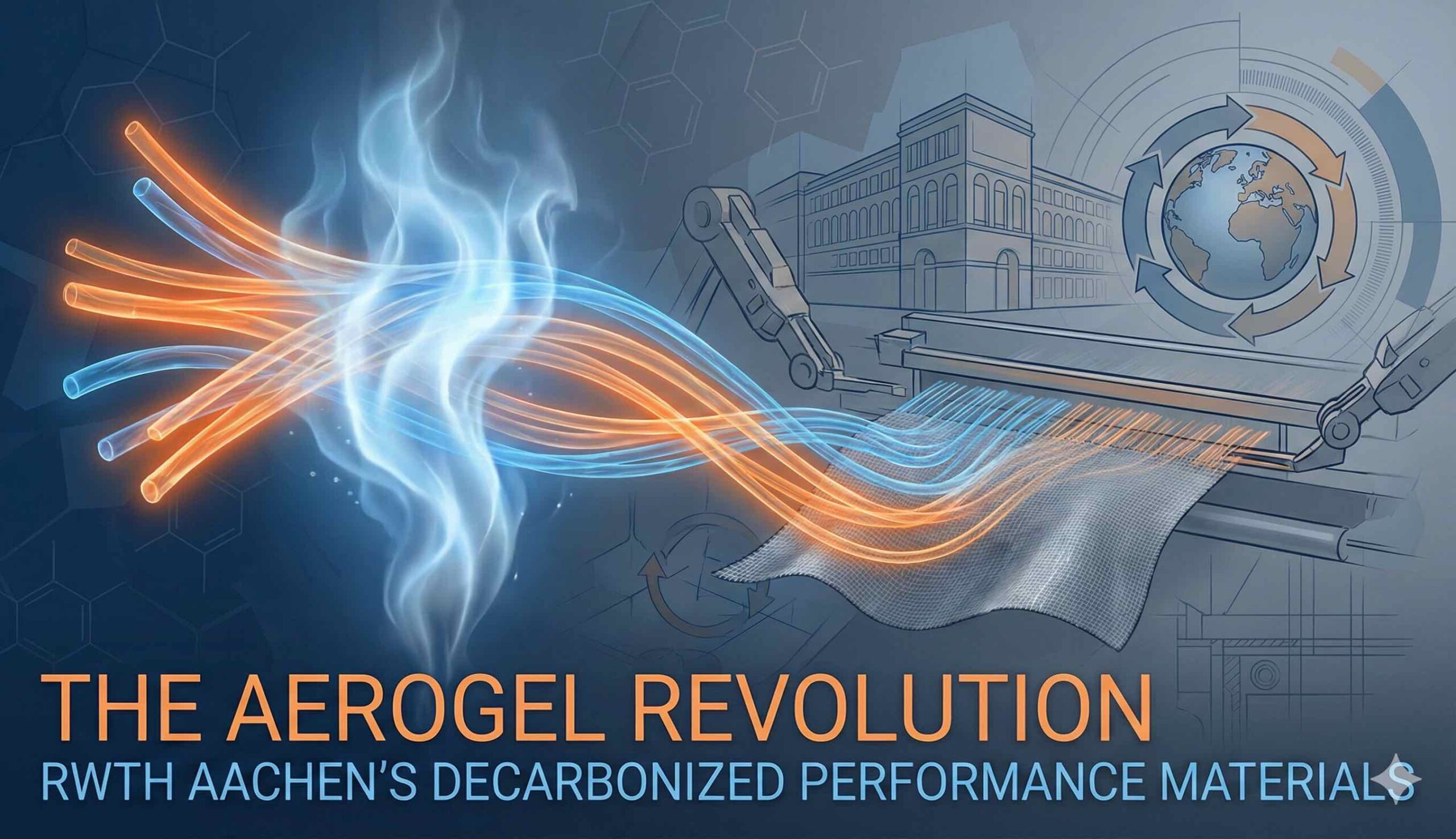

The quest for the perfect insulator has long been a battle against the second law of thermodynamics, but a new class of «frozen smoke» fibers is promising to keep us warm without the carbon cost.
For decades, aerogels—often called «frozen smoke» because they are composed of over 90% air—were the darlings of aerospace engineering but the pariahs of commercial manufacturing. Their brittle nature made them nearly impossible to weave into the flexible, durable materials required for everyday life.
However, as of February 16, 2026, a team from RWTH Aachen University has signaled a major shift in the materiality of the circular economy. The university’s latest spinout (recognized today at the RWTH Innovation Awards) has successfully developed high-performance insulation fibers derived from renewable raw materials that maintain the near-supernatural thermal properties of aerogels in a flexible textile form.
The Materiality of Air
The startup, led by founders from the Institut für Textiltechnik (ITA) and the Department for Industrial Furnace and Heat Engineering (IOB), addresses a critical gap in the performance apparel market. Current high-end insulation relies heavily on synthetic microfibers or animal products, both of which carry significant environmental and ethical overhead.
By utilizing aerogel fibers, the Aachen team is effectively «commoditizing air.» Because the fibers are so porous, they provide superior thermal resistance with a fraction of the weight of traditional materials. In an era where «ultra-lightweight» is the primary metric for everything from mountaineering gear to electric vehicle cabin insulation, this spinout is positioning itself as the foundational layer for a decarbonized supply chain.
The European Innovation Act: A New Wind
This breakthrough comes at a pivotal moment for European deep tech. The European Commission recently unveiled a draft for the EU Innovation Act, scheduled for early 2026. The act aims to harmonize the «regulatory sandboxes» that allow startups like the Aachen team to test industrial-scale production without the crushing weight of fragmented cross-border rules.
Crucially, the legislation addresses the «state aid» hurdles that have historically prevented universities from giving their spinouts preferential access to high-cost research infrastructure. For a material science startup that requires specialized furnaces and textile looms, this policy shift could be the difference between a lab-scale prototype and a global manufacturing standard.
The Bottom Line
The success of the Aachen spinout underscores a broader trend in the 2026 innovation landscape: the most valuable university startups are no longer just those with «digital» solutions, but those solving the «hard» problems of matter and energy. As Germany leads the world in circular economy technologies, the transition from «frozen smoke» in a lab to aerogel fibers in a jacket represents the next chapter in the industrialization of science.