

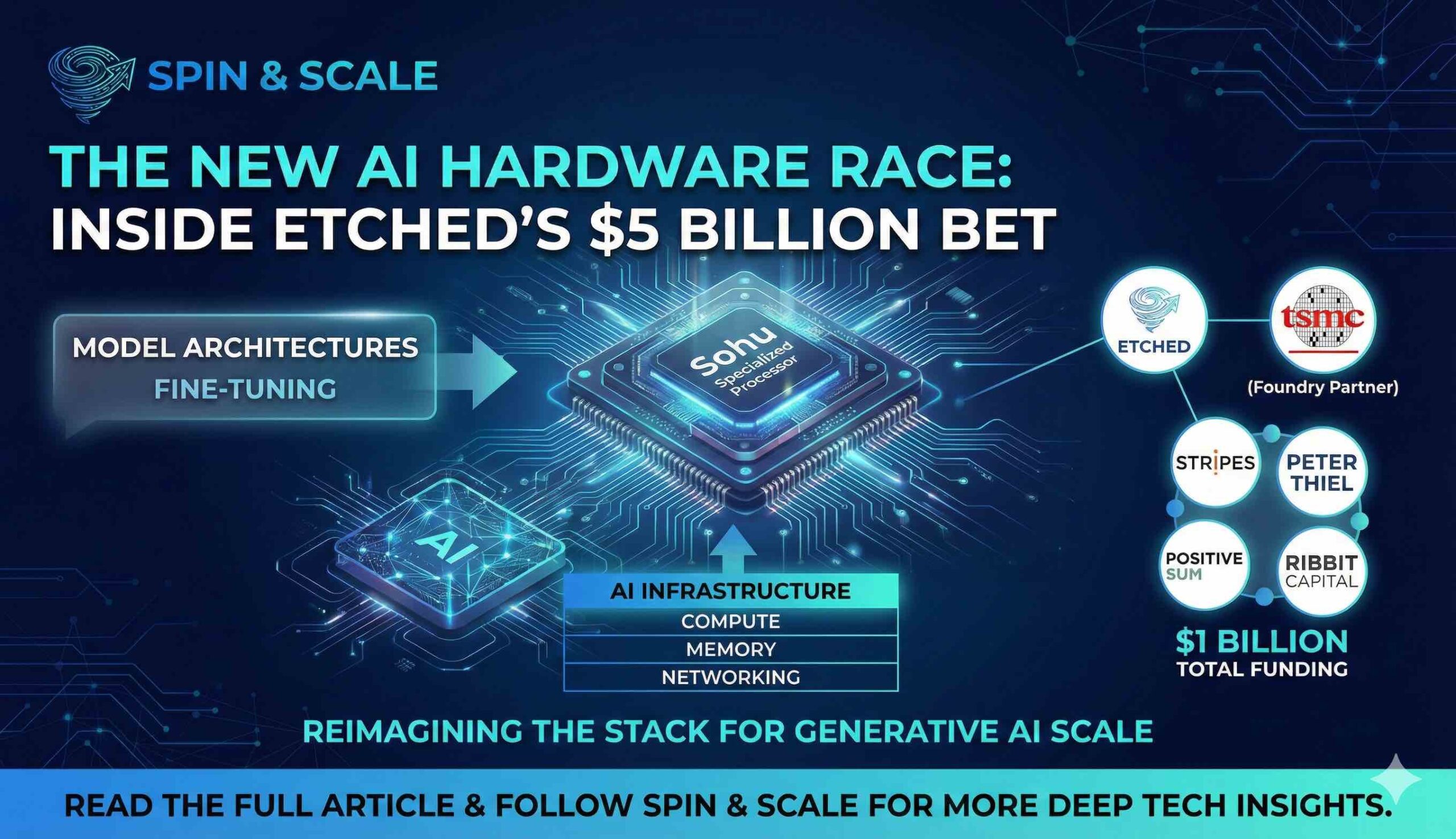

It’s Etched , a San Jose startup trying to reimagine the hardware stack beneath them.
The hottest AI unicorn this week doesn’t build models—it builds the silicon that might one day undercut Nvidia’s grip on them. Etched , an AI chip spinoff headquartered in San Jose, has reportedly raised around $500 million in fresh capital at a valuation of roughly $5 billion, joining a new wave of startups racing to redesign the infrastructure of generative AI.
The company’s pitch is straightforward and ambitious: a specialized processor, dubbed Sohu, tuned for the escalating compute demands of training and running large AI models. Instead of chasing general-purpose flexibility, Etched is betting that tightly targeted acceleration can deliver better performance per watt—and per dollar—than today’s go‑to GPUs.
That thesis is attracting heavyweight backers. The latest round is led by growth investor Stripes and includes Peter Thiel alongside firms such as Positive Sum and Ribbit Capital , bringing Etched’s total funding close to the $1 billion mark. In a market where AI startups regularly raise at eye‑watering valuations, landing that level of capital for infrastructure rather than applications signals where investors expect the next bottlenecks—and returns—to be.
Etched is also making a pragmatic choice on manufacturing. The startup has aligned with TSMC Emerging Businesses Group, effectively renting advanced foundry capabilities instead of trying to reinvent the fabrication stack. That partnership, plus a roster of engineers drawn from legacy chipmakers like Cypress Semiconductor and Broadcom, gives the company a credible path from PowerPoint to production silicon.
For AI spinoffs, the message is clear. The next phase of the boom won’t be won only by new model architectures or clever fine‑tuning tricks. It will hinge on who can deliver sustainable compute at scale—economically, thermally, and geopolitically. Etched is an early, well‑funded test of whether a focused startup can carve out space in a universe dominated by incumbents like Nvidia and TSMC.
If the bet pays off, Sohu‑class accelerators could give enterprises and sovereign AI builders a new option in a landscape that is currently capacity‑constrained and strategically sensitive. If it fails, it will be another reminder that in AI hardware, technical ambition is the easy part; getting reliable, mass‑produced chips into real data centers is where the physics, economics, and supply chains all start to fight back